
The Fantastic Five: Amazing hemorrhage control items every civilian has access to.

Updated: Dec 1, 2025
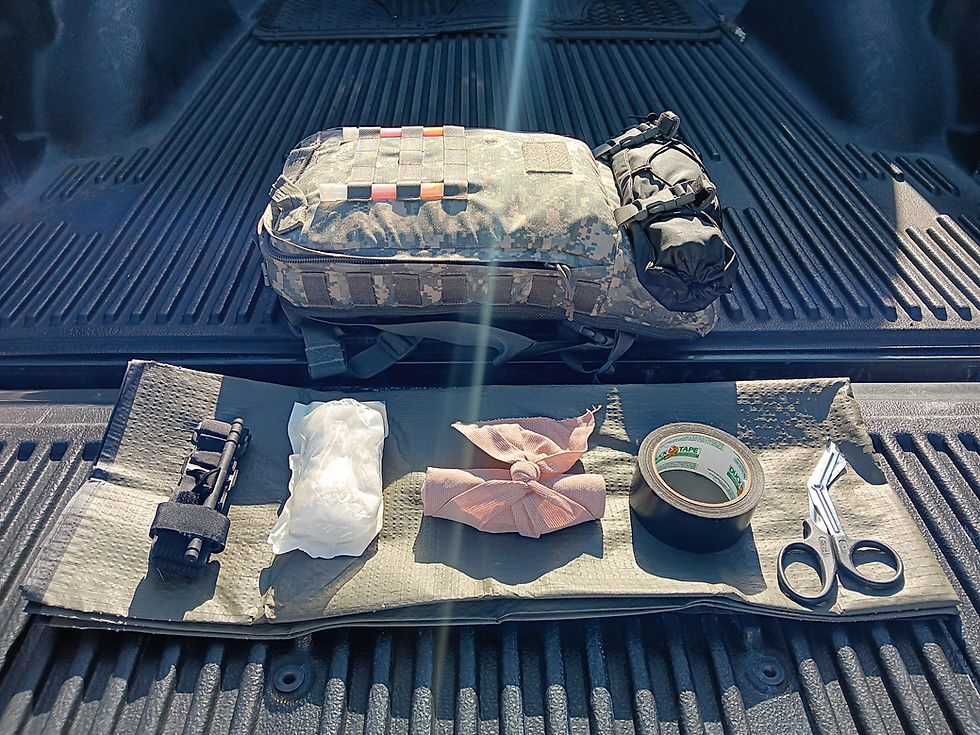
If I could only pick five items to control bleeding, what would they be?
For me, this isn't even a hard decision. They would be the exact same items I've used in war and right here in the U.S.A that are time tested, proven, easy to use and effective. Seriously, though, can we take a second and admire that picture up top? The tools of heroes on a beautiful fall morning in the greatest country on earth. Damn, I freaking love living in America.
In the few years I was deployed as a medic in the army, gunshot wounds were the name of the game. I did experience a few casualties with explosive device injuries and one suicide bomber, but it was mostly gunfights that got my hands wet.
Unfortunately, today I see things on the news that remind me of those years. Soldiers getting shot while patrolling a street is definitely one of them. Even sicker and sadder is hearing of random bystanders being shot for no reason while going about their day in random acts of mass violence.
So, if I was going out for a regular American day what items would I pick to load out my bag to control bleeding if I could only choose five?
I like to keep it simple and I'm a huge fan of fundamentals. It's the foundation of what we do and so effective we start novices with them. This is why I stick with most fundamental approach to bleeding that I was ever taught. Simple, quick and effective.
I'm going to tie off the limbs, pack the junctions and seal the box.

This was important enough for me to learn at my beginner level and it was serious enough to be taught again at the higher levels. In all my experiences in TCCC courses, this was engrained into me and other students over and over. That means from initial combat medic training all the way to special operations level TCCC courses. Yes, I did put this to the test in the real world and more than once.
So, if I could only have five items to tackle the most important part of TCCC medicine and the number one preventable cause of death on the battlefield, this would be my go-to every time.
The Fantastic 5

The CAT tourniquet Gen 3
Inexpensive at around $30 and one of the backbones of battlefield medicine from the War or Terror. Still preferred by yours truly today.
Extra-large ROLLS of sterile kerlix
Wound packing is essential for controlling hemorrhages at the junctions and for pressure dressings. The most effective technique I've ever been taught was in a pre-deployment workup course and very exclusively uses rolls, not compressed forms of kerlix. I even had the chance to use that same technique on three urgent surgical patients at once in Afghanistan and they all lived despite severe injuries and bleeding.
Six-inch-wide rolls of ace wrap
These are also a part of the pressure dressing technique that I was taught and used down range. Take them out of the plastic, toss the metal clips and tie a knot on the exposed tail about five inches below the end like the picture above.
Duct tape
There are a million ways this becomes useful. The most important for me is securing an intervention like your tourniquet. You'd be surprised how a violent movement to safety can loosen or even remove a tourniquet. This actually happened to a teammate of mine in Iraq named Shane.
Trauma sheers
You'll need these to remove clothing and expose the wounds you're trying to treat.
But Doc, what about chest seals!? Didn't you say we needed to seal the box?
Look closely, and you'll find it hiding in that list. Although, you're going to have to make it yourself. In fact, there was a time when the men and women who came before you were actually using that technique. (The plastic wrap from your kerlix, the duct tape and your trauma sheers) I'm still serious, it was a real thing back in the day. Just ask the gray beard at the schoolhouse.
If you were expecting a five hundred dollar "special opps" medical kit from a YouTube channel you are very mistaken.
This isn't medical advice, y'all. This is just an opinion of a washed up has been. In fact, he's in the photo right below. Looks like his very first patient after his first firefight, too. As a matter of fact, I see all three of these scenarios in this photo. The limb, the junction and the box. I even see that supper cool pressure dressing with rolled kerlix and ace wrap.

In my best Dora the Explorer voice...
..."Do youuuuuuu see the limb, junction and box?"...
We can all look at that photo and agree my first time was a bit sloppy. I would ask the great masters of the internet to show me mercy in any comments and remember it was my first time. Let's all also try to remember one thing...
He lived...
Our day-to-day American lives are changing, y'all. It hurts me to say that. Lots of you are obsessed with purchasing fancy guns and shooter training to "stay ready". I would argue it might be a useful skill to know how to save lives too if you want to stay ready. Maybe you should invest as much money in a TCCC course as you do in fancy guns? It might just be your wife or child that thanks you for it and I can personally vouch it's a pretty good return for the investment. Just a thought from a has been with a keyboard.
Y'all take care and stay safe.
Doc out.


Comments